Face shape analysis: what is my face shape?
Your face shape is the cheat code behind almost every great haircut and pair of glasses you have ever envied on someone else. It is not about which shape you have, every shape has looks that sing on it. It is about knowing yours, so you stop guessing and start choosing. Here is how to measure it yourself, what the 7 shapes mean, and why an AI read from a selfie beats squinting at a mirror.
How to figure out your face shape
Pull your hair back, face a mirror straight on, and take four measurements: the width of your forehead at its widest, the width across your cheekbones, the width of your jawline from corner to corner, and the length of your face from hairline to chin. Then compare. If everything is roughly even with a gently rounded jaw, you are likely oval. Widest at the cheekbones points to round or diamond. Widest at the forehead points to heart. Widest at the jaw points to square or triangle. If your length is clearly greater than your width, you are in oblong territory.
That is the manual method, and it works, as long as you hold the tape straight, judge your own hairline honestly, and do the comparison right. Most people do not, which is where AI comes in. More on that below.
The 7 face shapes
Every shape below comes with built-in advantages. The notes on hair and glasses are about harmony, choosing lines that work with your proportions, never about correcting anything.
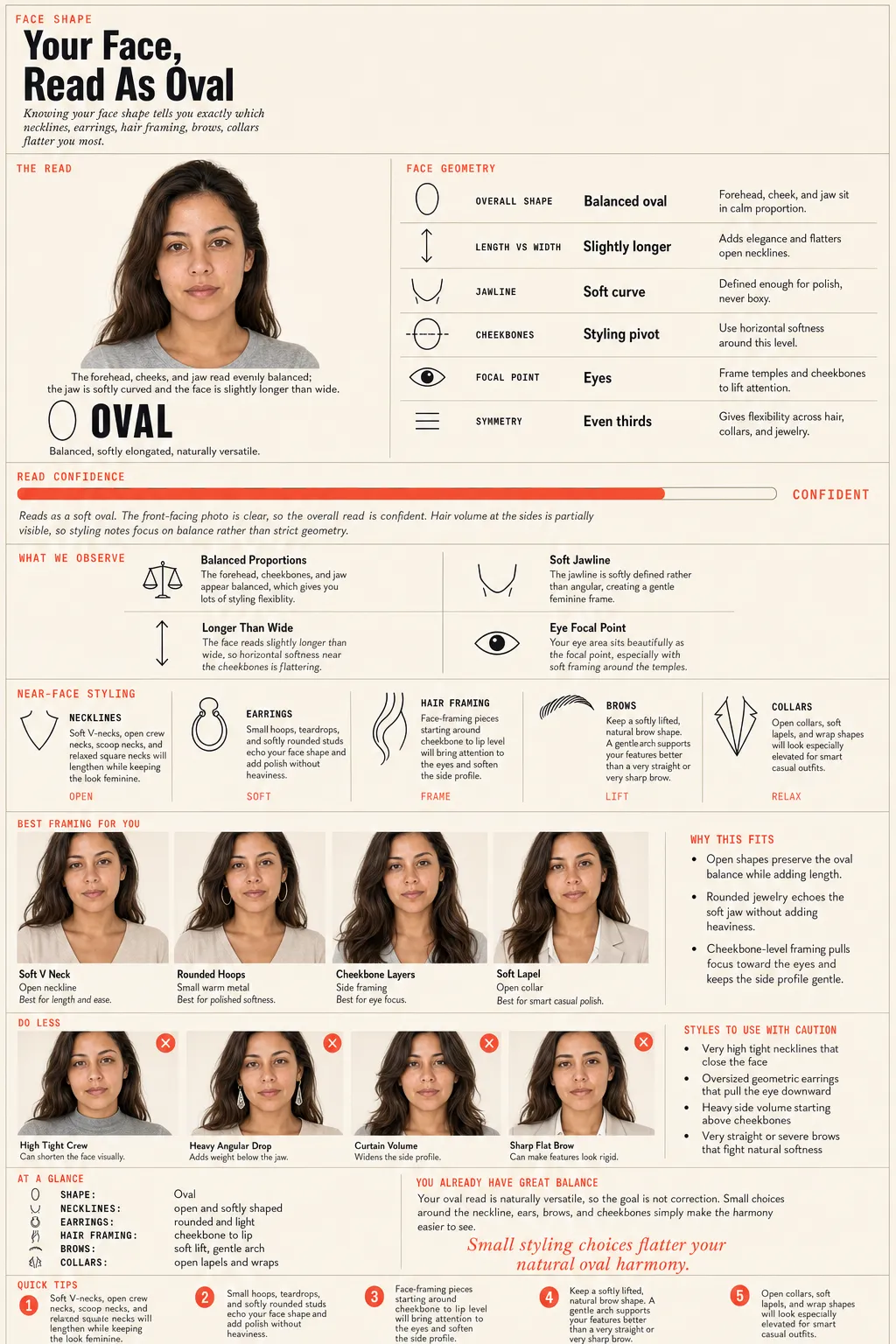
Oval
Balanced proportions with a gently tapered jaw. Almost any haircut and frame works, so your real move is picking looks that show off your favorite feature.
Full oval guide →Round
Soft width with full cheeks that read warm and youthful. Height on top, longer layers, and angular or rectangular frames add structure that lets that softness shine.
Full round guide →Square
A strong, photogenic jawline that gives faces presence. Soft layers, side parts, and round or oval frames play beautifully against all that natural architecture.
Full square guide →Heart
A wider forehead tapering to a delicate chin, a naturally striking silhouette. Chin-length cuts, side-swept fringe, and bottom-heavy or rimless frames balance it elegantly.
Full heart guide →Diamond
High, prominent cheekbones as the widest point, the shape stylists love to work with. Texture at the forehead and chin, plus oval or cat-eye frames, frames those cheekbones perfectly.
Full diamond guide →Oblong
Elegant length with refined, even features. Side parts, waves, and fringe add width, and tall or oversized frames keep everything in graceful proportion.
Full oblong guide →Triangle
A confident jaw wider than the forehead, grounded and distinctive. Volume up top, layered crowns, and frames with strong upper detail (like browline styles) create a striking balance.
Full triangle guide →Why AI analysis beats guessing in a mirror
Self-assessment has a built-in problem: you cannot see your own face objectively. You judge your jaw against a memory of someone else's, your mirror flips you, your camera lens distorts at selfie distance, and most faces blend two shapes anyway. An AI reads the actual proportions in your photo, forehead to cheekbone to jaw to length, as measured ratios rather than vibes, and applies the same standard to every face. The result is a confident answer in seconds instead of twenty minutes with a tape measure and a fogged-up mirror. These are AI-generated style suggestions, a sharp starting point you then test against your own taste.
What Lookcard's face-shape page gives you
Face shape is one page of the full 15-page Lookcard report, and it is the page that unlocks several others. You get your shape, read from your own selfie, plus what it opens up: hair directions chosen for your proportions, glasses frame styles that sit right on your face, and neckline guidance so your collars and necklines frame you instead of fighting you. Later pages render those looks on your own face, so you see them working before you commit. Your selfie is deleted after the report is built.
Go deeper: see the whole AI style report, turn your shape into a haircut with the AI hairstyle finder, find glasses for your face shape, or browse a real sample report.
Questions
What is the most common face shape?+–
Oval and round shapes are generally the most common, but most real faces are a blend of two shapes, like a square jaw with oval length. That blend is exactly why measuring beats eyeballing, and why an analysis that reads your actual proportions is more useful than a generic chart.
Can I be a mix of two face shapes?+–
Absolutely, and most people are. If your measurements land between two shapes, the practical answer is to borrow recommendations from both: for example, a square-oval face can carry strong frames and almost any haircut. Lookcard reads your dominant shape and tailors suggestions to your actual proportions, not a textbook category.
Does my face shape change with age or weight?+–
The underlying bone structure stays the same, but cheek fullness and jaw definition can shift with weight changes and age. If your face has changed noticeably, it is worth a fresh look, since your best hair and frame choices may shift a notch too.
Is one face shape better than the others?+–
No, and anyone selling that idea is selling. Every shape has haircuts, glasses, and necklines that sing on it. The whole point of knowing your shape is to skip the trial and error and go straight to the looks built for you.
What happens to my selfie?+–
It is deleted after your report is built. We only need it long enough to analyze your proportions and render your looks; your face stays your business.